2024 Modernization : The fulfillment
AI-powered workflow changes cut task completion time 30%
Leading design vision for the ambulatory nursing experience at Oracle Health, where native AI finally made a decade of research executable
My Role
Sr. UX Strategist
Organization
Oracle Health
Year
2024
Artifacts
Presentation
This work is available for a deeper walkthrough — reach out to schedule a conversation.
The outcome
AI-assisted documentation, intelligent task prioritization, and automated contextual summaries reduced task completion time by 30% in the nursing workflow I led design vision for, while maintaining quality standards.
I served as domain expert across Oracle Health's broader Gen 2 design team, supporting 25+ designers, while leading the nursing experience specifically. Three concepts I first prototyped in 2015 (ambient documentation, patient timeline, contextually aware patient information) are now shipping in the Gen 2 platform.
30%
Reduction in task completion time through AI-powered workflow optimization
25+
UX professionals supported as domain expert across the clinical platform
17
Pending patent co-inventions across the body of work
Still In progress - EHR Prototype
I continue building on this work in an interactive prototype of the ambulatory workflow, so the direction can be tried, not just read about.
This prototype walks through an ambulatory office visit from rooming through wrap-up, alternating between nurse and physician views with medication reconciliation as the central thread. Click the user chip in the lower-right to advance the scenario at your own pace, your active role changes with each stage. The medication flow can also be opened from the Begin intake card in the right Action Items.
The prototype is password-protected. Reach out and I'll share access.
How We got there
Oracle’s native AI created the conditions the research had always pointed toward.
EHRs were designed as data repositories, leaving clinicians to do the cognitive work of locating, retrieving, and assembling information at every step of care. Oracle Health's native AI finally closed that gap, pulling fragmented data into context and surfacing it without the clinician having to go find it. In Gen 2, I served as domain expert across the design team and led the nursing experience vision specifically, applying this research to the full arc of a patient encounter.
The problem
Care orchestration is the hardest unsolved problem in healthcare UX.
Care orchestration, the handoffs across scheduling, the visit itself, and follow-up, is one of healthcare's hardest unsolved UX problems: before the encounter clinicians assemble scattered information themselves, during the encounter coordination happens informally through memory and conversation, and after the encounter referrals go unconfirmed and the system loses track of the patient. The system needs to not just support care, it needs to orchestrate it, closing the loop without adding manual burden to people already carrying too much.
Every moment, anticipated
Ambulatory nursing experience vision, the most complex version of the original problem, applied to nursing workflow across the full arc of a patient encounter.
This vision demonstrates the idea at full resolution. The nursing experience follows Nurse Linda and patient Sam through a complete ambulatory encounter — from Sam’s initial AI-assisted scheduling call through Linda’s afternoon phone triage. At no point does Linda have to forage for information. The system carries it to her.
Where the system carries the burden — key moments
Scene 1
AI schedules the appointment
Sam calls with symptoms. An AI scheduling assistant understands her situation and books on her behalf. Her only job is to rest.
Scene 3
Linda gets oriented before the day begins
A dynamic, role-specific schedule gives Linda a bird’s-eye view and the ability to drill into detail. She’s prepared before stepping into the clinic huddle.
Scene 6
Bird’s-eye view surfaces what Linda needs to know
A dynamic, role-specific schedule gives Linda a bird’s-eye view and the ability to drill into detail. She’s prepared before stepping into the clinic huddle.
Scene 7
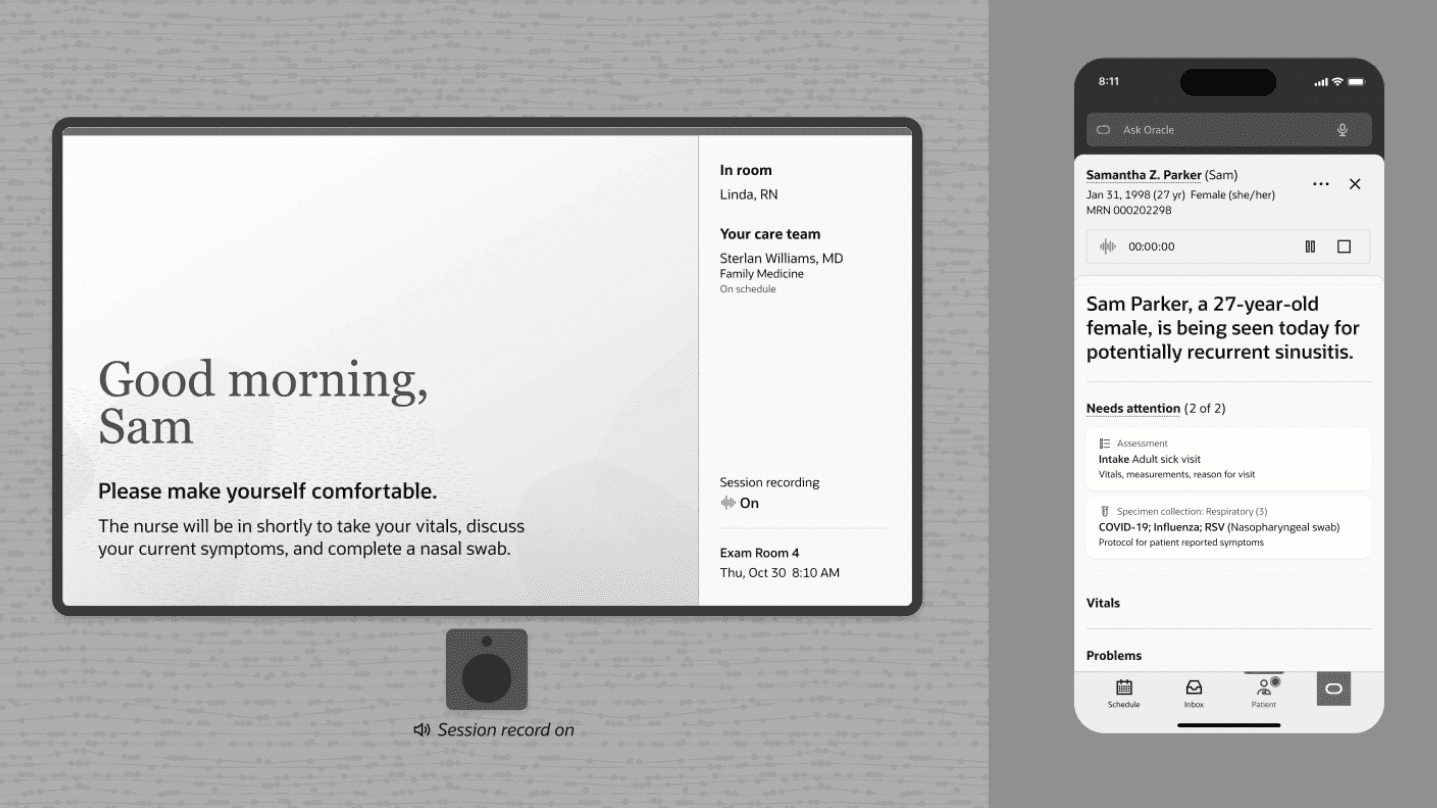
Ambient listening handles documentation
With Sam’s consent, ambient listening documents the conversation in real-time — adding new symptoms, updating the family history, confirming medication lists. Linda focuses on Sam, not the screen.
Scene 8
Earpiece notification with contextual summary
A priority notification in Linda’s earpiece tells her Gracie has checked in, summarizes her situation, and recommends an accessible room. Linda acts — she doesn’t research.
Scene 10
Phone triage with AI-assembled context
An 85-year-old patient's son calls about an ED visit. The system has already pulled the patient’s last visit, the ED discharge summary, and recommended next steps. Linda follows protocol — she doesn’t forage.
Independent validation of the direction
Oracle Health's own Clinical AI Agent product materials describe a nursing AI agent that lets nurses capture discrete data in near real time, reducing administrative tasks and freeing up time for direct patient care. https://www.oracle.com/health/clinical-suite/clinical-ai-agent/
A November 2025 AHA Knowledge Exchange report, sponsored by Oracle Health, includes client health system leadership describing measurable productivity gains and reduced after-hours documentation following ambient AI adoption on the nursing side.
https://www.aha.org/system/files/media/file/2025/11/ke-oracle-ai-powered-healthcare-optimize-clinical-workflows.pdf
This is industry validation of the direction I’ve been building toward since 2015, not a claim about my own metrics above.