2020 Legacy - The validation
A boardroom pitch secured funding for the platform’s entire go-forward vision
Selected by VP-level leadership to represent Cerner’s clinical direction to the Board, and validated a strategy argument built over five years, in one presentation.
My Role
Sr. UX Strategist
Organization
Cerner Corporation
Year
2020
Artifacts
Presentation
This work is available for a deeper walkthrough — reach out to schedule a conversation.
outcomes
Selected by VP-level leadership as the platform's boardroom-ready go-forward vision
The clinical UX work was considered boardroom-ready — selected by VP-level leadership to represent the platform’s go-forward vision to the Board of Directors
The demo made the case for investment in a unified, patient-centered experience across the full care continuum — not as a concept, but as a demonstrated, designed reality
The design principles embedded in the clinical portion — contextual awareness, information delivery without foraging, continuity across touchpoints — became the platform's funded direction
Demonstrated that a UX strategy argument, built over five years of research and design, could hold up at an executive level and secure organizational commitment
The context
The platform needed funding and organizational alignment to execute the vision at scale
By 2020, the design direction was clear. Five years of research, strategy work, and architectural decisions had established what the platform needed to become: a contextually intelligent system that carried the cognitive burden for clinicians rather than placing it on them. The remaining challenge was organizational. Executing that vision at scale required executive commitment, prioritized investment, and alignment across product, engineering, and clinical leadership.
I was brought in by our VP of UX to work alongside executive product leaders on a presentation that would make that case to the Board of Directors. My responsibility was the clinical portion of the demo — the piece that had to show, not just describe, what the experience could be.
The work
A single patient. Eight connected touchpoints. The system never losing focus on the person.
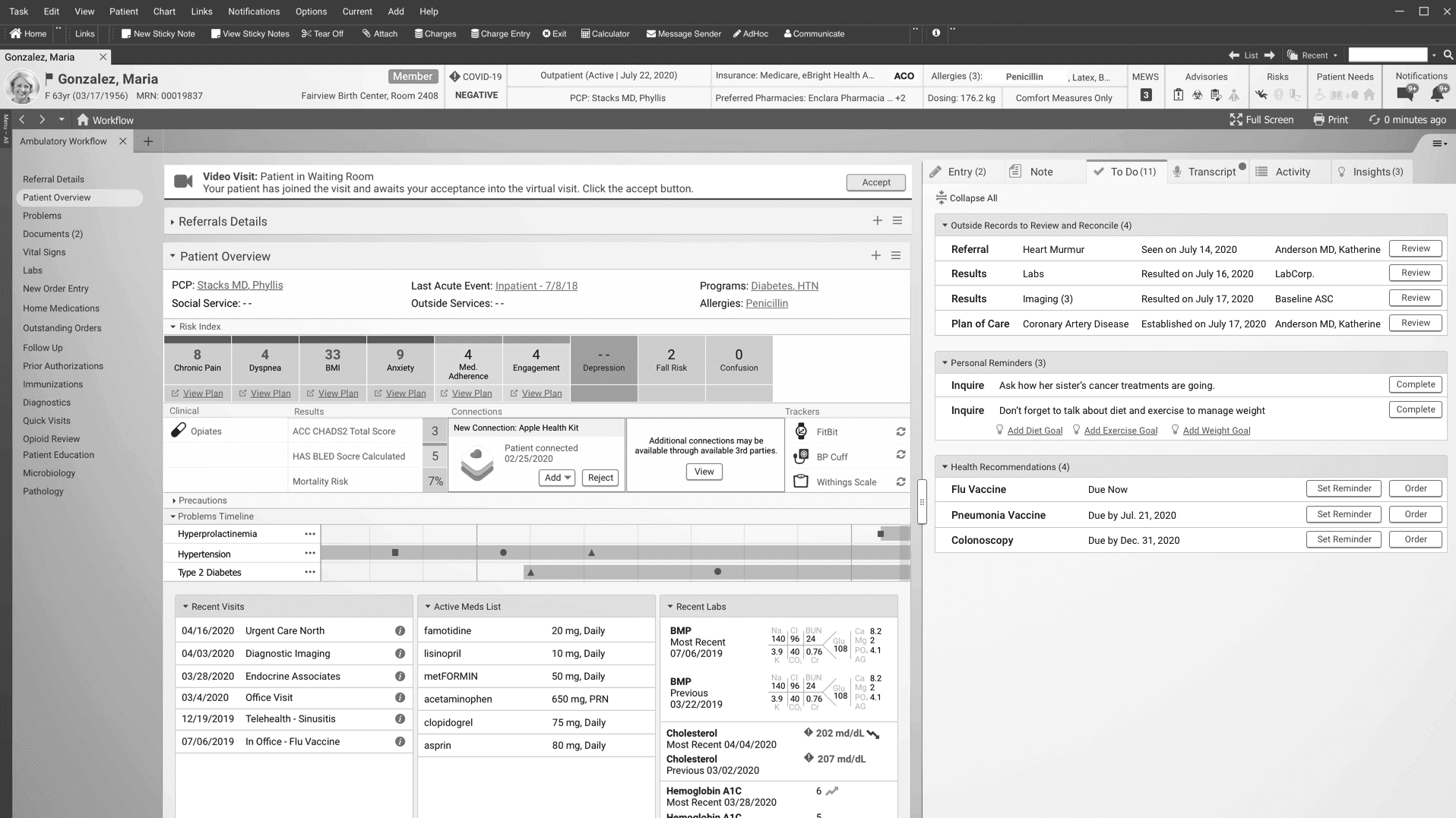
The demo followed one patient across the full arc of her care at a large health system. My contribution was designing the clinical experience at each touchpoint: what the clinician saw, what the system surfaced without being asked, and how information flowed across the care team without requiring anyone to forage for it.
At every stage the design demonstrated the same principle. The system knew where the clinician was, what the patient needed, and what information was relevant to that moment. The closing line of the presentation named what the design had been demonstrating throughout: we introduced multiple care professionals, venues, and service lines — and never lost focus on the patient.
Patient journey across the demo
01
Awareness and engagement
Proactive outreach based on care gaps
02
Screening and scheduling
Appointments filtered by preference and insurance
03
Financial clearance
Eligibility resolved before arrival
04
Pre-visit intake
Forms and consents completed digitally at home
05
Arrival and check-in
Registration frictionless — intake already complete
06
Clinical encounter
Clinician oriented to patient context before entering room
07
Cardiology episode
Integrated diagnostics without system switching
08
PCP follow-up
Longitudinal care plan with compliance trends
The board presentation closed one chapter and opened the next. The vision had been validated at the highest level. What remained was the technology to fully execute it. That arrived with Oracle and native AI, and the direction that started with a nursing prototype in 2015 finally had everything it needed.