2018 Legacy - The Pivot
A demo that changed the platform’s direction
A vision I authored showed the platform needed more than incremental fixes, reshaped five platform-level design directions immediately, and the concepts themselves resurfaced years later in Oracle Health's Gen 2 platform.
My Role
Sr. UX Strategist
Organization
Cerner Corporation
Year
2015 - 2018
Artifacts
Presentation/Research
This work is available for a deeper walkthrough — reach out to schedule a conversation.
This work built directly on the diagnosis I'd already put in motion in 2015. By 2018, I had the demonstrated vision the organization needed, and I pitched it as a 2 to 5 year platform investment roadmap, not a finished deliverable.
Organizational Impact
Five platform directions shifted immediately. The larger vision arrived years later, in Gen 2.
Notification philosophy — a platform-wide framework replacing ad hoc alert design with a principled, research-grounded model
Reinforced design standards — consistency reframed as a clinical safety issue, not a visual preference
Interface simplification — cognitive load reduction adopted as an explicit design priority across the clinical application
Clinical results display improvements — better information hierarchy to reduce manual interpretation burden
Interoperability interface improvements — design investment in the experiences where information crossed system boundaries
The research and strategy work became a reference point for other UX strategists across the clinical portfolio — shaping how parallel workstreams framed their own problems and design directions
Following Oracle's acquisition of Cerner, three concepts from this vision, ambient documentation, the patient timeline, and contextually aware patient information, shipped in Oracle Health's Gen 2 platform.
The Vision
The research produced a demonstrated concept, not just a report
“Contextual and Intelligent Experiences: Supercharging our solutions to remove the cognitive burden from our end users”
Cerner 2018 — the vision that showed incremental fixes wouldn't be enough
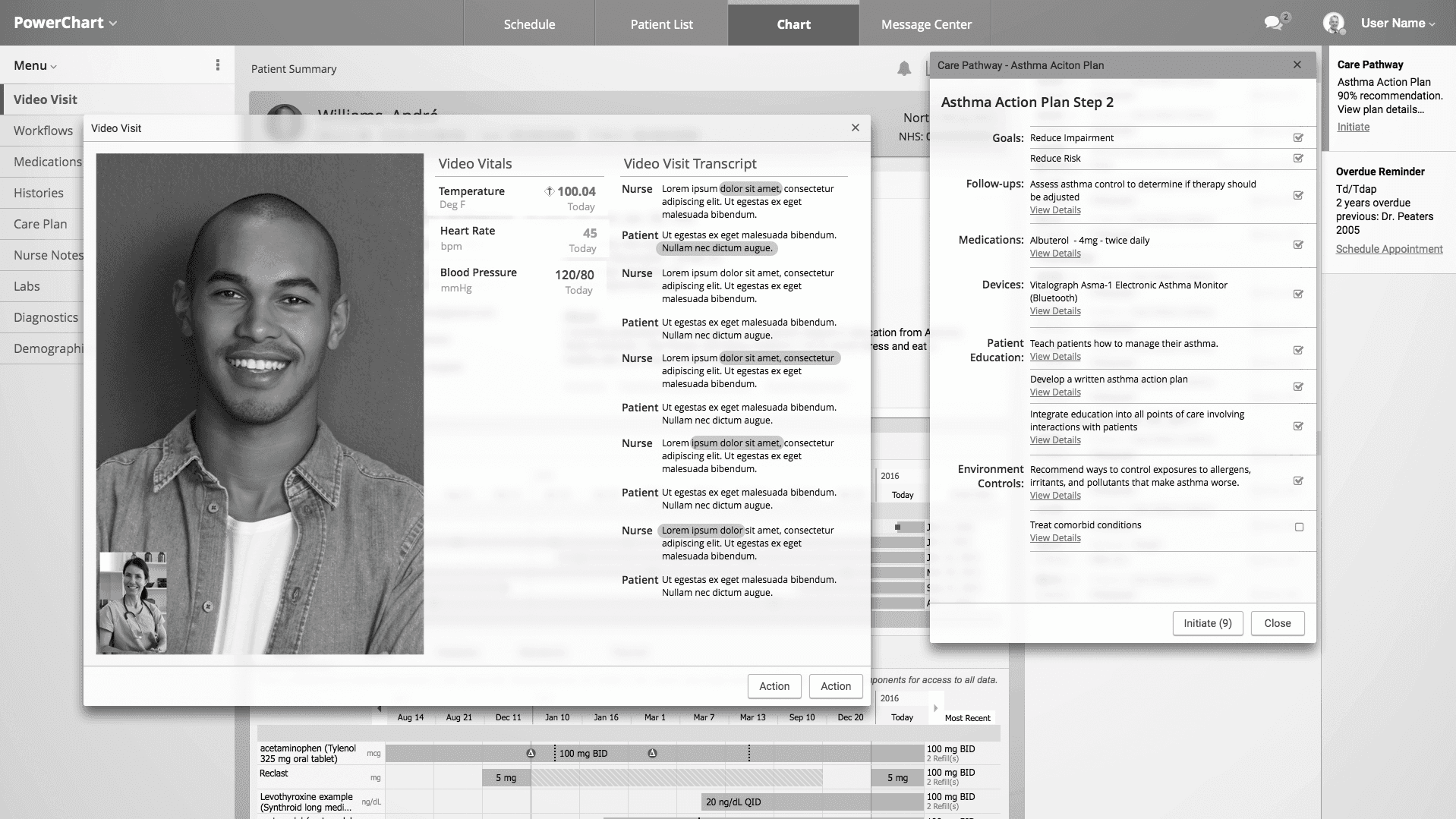
I authored a demonstrated vision showing what a contextually intelligent experience could look like across the full patient journey. The demo followed a single patient — André — from voice-activated AI scheduling through Alexa, through a video visit with real-time automated documentation, to smart device integration transmitting peak flow data directly to his chart, to an algorithm-triggered status escalation that notified his Care Manager through a Population Watch List.
Every moment in the demo answered the same question: where is the system carrying the burden so the clinician doesn't have to? My strategy work had not just identified the problem. It had shown what solving it looked like.
Patient side
Voice-activated AI scheduling
Alexa books the appointment based on symptoms, insurance, and preferences. Patient’s only job is to rest.
Clinical Side
Automated documentation
Video visit transcribed and processed in real-time. Care pathways surfaced contextually. Clinician focuses on patient.
Care management
Algorithm-triggered escalation
Peak flow meter data triggers status change. Care Manager notified via Population Watch List before patient deteriorates.
The problem
The platform had met its regulatory obligations and failed its users
Meaningful Use compliance had been achieved. But across clinical research between 2015 and 2018, a different picture was emerging. Clinicians couldn’t understand the patient story from within the EHR. They had to go to multiple places to manually assemble information that should have been coherent and accessible. The order of clinical events mattered deeply to care decisions — and the system made that order nearly impossible to see.
The root cause was architectural. The EHR had been designed as a data repository and the clinician was expected to be the intelligence layer. They had to forage for information every time, for every patient, at every stage of care. All of the cognitive work the system should have been doing was being offloaded entirely onto them.
The Research
75
Clinicians and staff across all workshops
4
Health system sites, multiple care settings
7
Structured research sessions per site
Multi-site research that validated the direction before the technology existed to build it.
Research I co-led with Human Factors confirmed changes needed prior to technology implementation.